

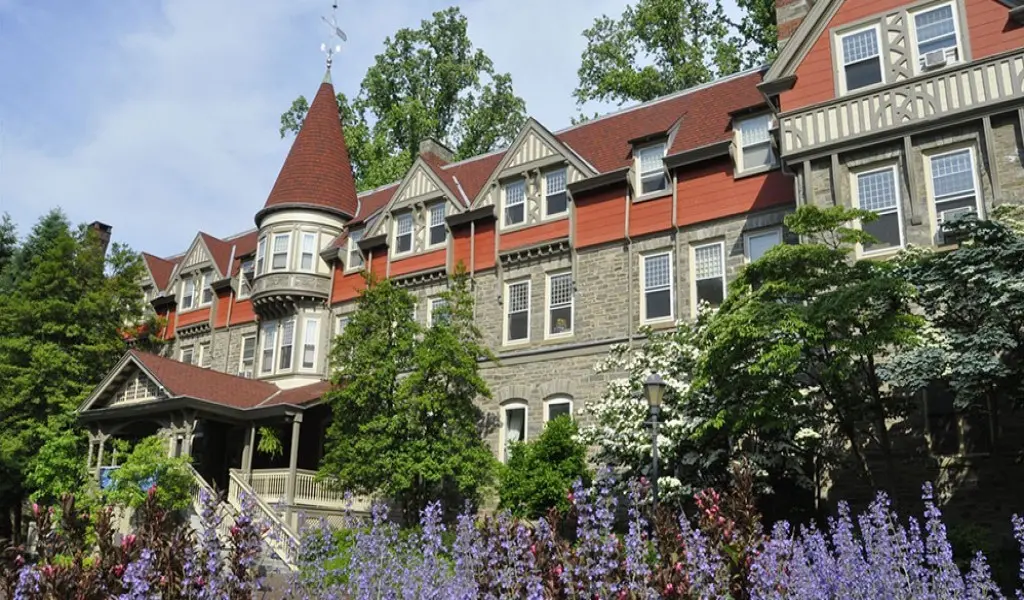


Springside Chestnut Hill Academy spans 62 acres in Philadelphia, Pennsylvania, with 16 buildings, city streets weaving through the middle of campus, and more than 1,300 students from early childhood to grade 12. Knowing who was where at any given moment had become one of the most time-consuming parts of the school day.
Deans spent two to three hours a day reconciling attendance
The problem was not a lack of effort. Before Orah, SCH's upper school attendance ran through the attendance module of its student information system. Entering a period's roll took 10 to 12 clicks, and over time many teachers treated it as optional. The main receptionist ended up calling classrooms ten minutes into each period to make sure attendance had been entered.
At the end of every day, the four upper school deans sat down to reconcile what had been captured. Was a student really absent from AP History, or was attendance simply not taken? Were they at the nurse? Had they left early for a game? Peter DiDinato, Chief Innovation Officer at SCH, describes it as "a two to three-hour morass every day," and says it consumed the majority of the deans' time.
The gap was also a safety issue. Upper school students can leave campus at certain times, employees step out for appointments, and public streets cross the property. "If we had a fire drill, we honestly couldn't track those kids," DiDinato said. "Or, heaven forbid, a true emergency."
The missed exams nobody caught until the end of the year
The tipping point came at final exams. Five or six teachers who shared the same student were in a room together when one mentioned the student had missed their exam. Then another said the same. Then another. The pattern of absences on test days had been there all year, spread across different subjects, and nobody had been in a position to see it.
"It was a light bulb moment for our head of upper school," DiDinato said. "We should have been able to intervene with this student and their family sooner. If we had better access to data, we could have done that."
SCH had first met the Orah team at the ATLIS conference. After the exam incident, the school committed to a multi-year plan to bring Orah to every division from early childhood through grade 12, starting with the upper school.
Live in a summer, with a handful of 30 to 45 minute calls
SCH built a cross-functional team of seven or eight people for the rollout: upper school administration, the deans, the registrar, the assistant to the upper school division, and several members of the technology team. The group met with Orah over the summer of 2025 in working sessions of 30 to 45 minutes. The registrar helped map the school's existing attendance codes and thresholds into Orah's alert system, so that a student accumulating three latenesses in a quarter now surfaces automatically rather than requiring anyone to count.
Faculty single sign-on through Google was configured in one of those sessions. "You turn it on, and you can have it done in probably 15 or 20 minutes with your door shut," DiDinato said. Once the setup was complete, the technology team stepped back. "It's set it and forget it. It's not something that me and my team are spending time in, really at all."
DiDinato's advice for schools considering Orah in June or July for the new school year:
"It is not a big lift from your team. It's probably a couple of 30 to 45 minute calls, and maybe one or two in August, and you'd be up and running."
Winning over 70 teachers by giving them time back
With around 70 upper school faculty, SCH did not put the decision to a vote. Instead, the rollout team led with empathy. Taking attendance was a chore, teachers wanted that time with students, and Orah would give it back.
With the Orah Chrome extension, teachers take attendance from a side panel in their browser in 10 to 15 seconds, without logging into the student information system. That saves roughly five minutes per class period, or about half an hour a day per teacher.
"If it does nothing else, it'll save you five or so minutes in every class period of taking attendance," DiDinato told faculty. "If that's the bottom of the barrel, then you just saved a half hour a day. And from there we can really scale up in terms of what the benefits were."
The trickiest moment was pre-first-day training, when the school year was not yet live and teachers were working with sample data. SCH appointed "floor captains" across its science, math, and humanities buildings to be the first line of support on day one. By day two, the typical reaction was, "Oh, that's all I have to do." By the end of the first week, DiDinato says teachers were comfortable using Orah on their own, and the remaining support tickets were parents asking for their invite.
Students with off-campus privileges check out by tapping an NFC tile with their phone, giving staff an immediate record of who has left campus and when. "That means we don't have to have a fire drill and say, 'Where is Emily?' We can just see in Orah that she checked out at this point, so we know she's off campus."
Parents onboarded with three emails and a firm cutover
SCH announced the change to parents in late August and early September 2025. The lesson from year one, now applied to the middle school launch in September 2026, is to over-communicate. Parents get three emails before launch: the first explains why, the second explains how, and the third is a reminder. Invites go out at exactly the time the school said they would.
The school also stopped supporting the old channels. The attendance email inbox and phone line were retired, and parents were directed to submit passes through Orah. Parents who prefer not to create an account can still submit a pass with their email address alone. A few months into the year, the upper school assistant took on first-line triage for absences without a pass, opening a conversation with those families directly.
In the 30 days to June 2026, SCH staff completed 3,123 attendance rolls and processed 4,393 passes through Orah.
Deans reclaimed 10+ hours a week and put it toward families
SCH estimates the deans saved at least 10 hours a week on reconciliation alone. Across a 45-week school year, DiDinato notes, that adds up to more than 10 weeks of work. He does not count the time formerly spent exporting attendance data to spreadsheets and updating it by hand.
The bigger change is how that time is used. Attendance patterns that once required manual counting now surface automatically, and the deans bring them to families early. "When you look at it and say, 'Hey, your student is missing 13% of school days,' that sounds much more significant than a couple days a month," DiDinato said. For students anxious about coming to school, that data has opened the door to earlier support and outside resources.
SCH's Head of Upper School summed up the first year:
"Orah is helping to streamline data and communication so that the upper school team is spending less time in the daily grunt work of attendance management and allowing them to reallocate that time to engaging families around student support."
"The idea that our deans, our head of upper school can be doing strategic work with families around student success is way better than them contacting parents to find out whether or not their kid was supposed to be at school that day," DiDinato said.
Year two: middle school, visitor management, and emergency roll call
SCH is in year two of its three-year plan. Middle school attendance launched in September 2026, visitor management is rolling out alongside it, and Orah's emergency roll call follows in October 2026 so staff can account for every student and visitor during a lockdown or fire drill. Year three brings the lower school and early childhood program onto the platform, including dismissal, with the goal of consolidating four separate tools into one.
"We could effectively replace four different things with one," DiDinato said. "That's very appealing, not just for us internally, but trying to lead with what is the parent experience, what are we asking of parents."
His recommendation to other schools is to name an in-house Orah owner on the academic side rather than in IT, since a system that simply works can end up with no one owning it. And his test for any tool remains the same: "Does this make our job easier and allow us to spend more time on what our mission is, and that's students. And Orah does that for us."


