Ontario Attendance-to-Marks Policy
Paul Organ
•
August 6, 2026
Starting with the 2026/27 school year, the Ontario government is changing how student attendance factors into report cards. Attendance will count for 15% of the final mark in grades 9 and 10 courses, and 10% in grades 11 and 12 courses. It's part of a broader push by the Ford government to address rising absenteeism, and although controversial, some staff and Deans that have to deal with it have been arguing for this for some time.
The shift matters to anyone who owns attendance day to day. If you're a Registrar, a Dean of Students or an Upper School Division Head, you already carry the accountability and visibility burden for attendance, the follow-ups, the parent calls, the pattern-spotting before a small problem becomes a big one. The moment attendance also determines a grade, everything you're already doing gets higher stakes and a lot less room for "close enough."
That's a workload and accuracy problem before it's a policy problem. Here's what changes when attendance counts for marks, and how Orah is built for exactly this shift.
Why "good enough" attendance data stops being good enough
Most schools have lived with attendance data that's directionally correct but operationally messy: rolls submitted late, teachers marking students present because it's faster than chasing down the real status, absences that don't distinguish between a school trip and a student who simply didn't show up. When attendance is just a compliance box, that messiness lands on your desk as an occasional annoyance.
When attendance is worth 10-15% of a course grade, it lands on your desk as a dispute. Parents will call. You'll need to explain, case by case, why a percentage landed where it did, and you'll need to do it with confidence, not with "let me look into that and get back to you." Attendance records need to hold up the same way a test score does: accurate, timestamped, and traceable to a source, without you having to reconstruct the story by hand every time.
"But doesn't Veracross / Blackbaud already handle this?"
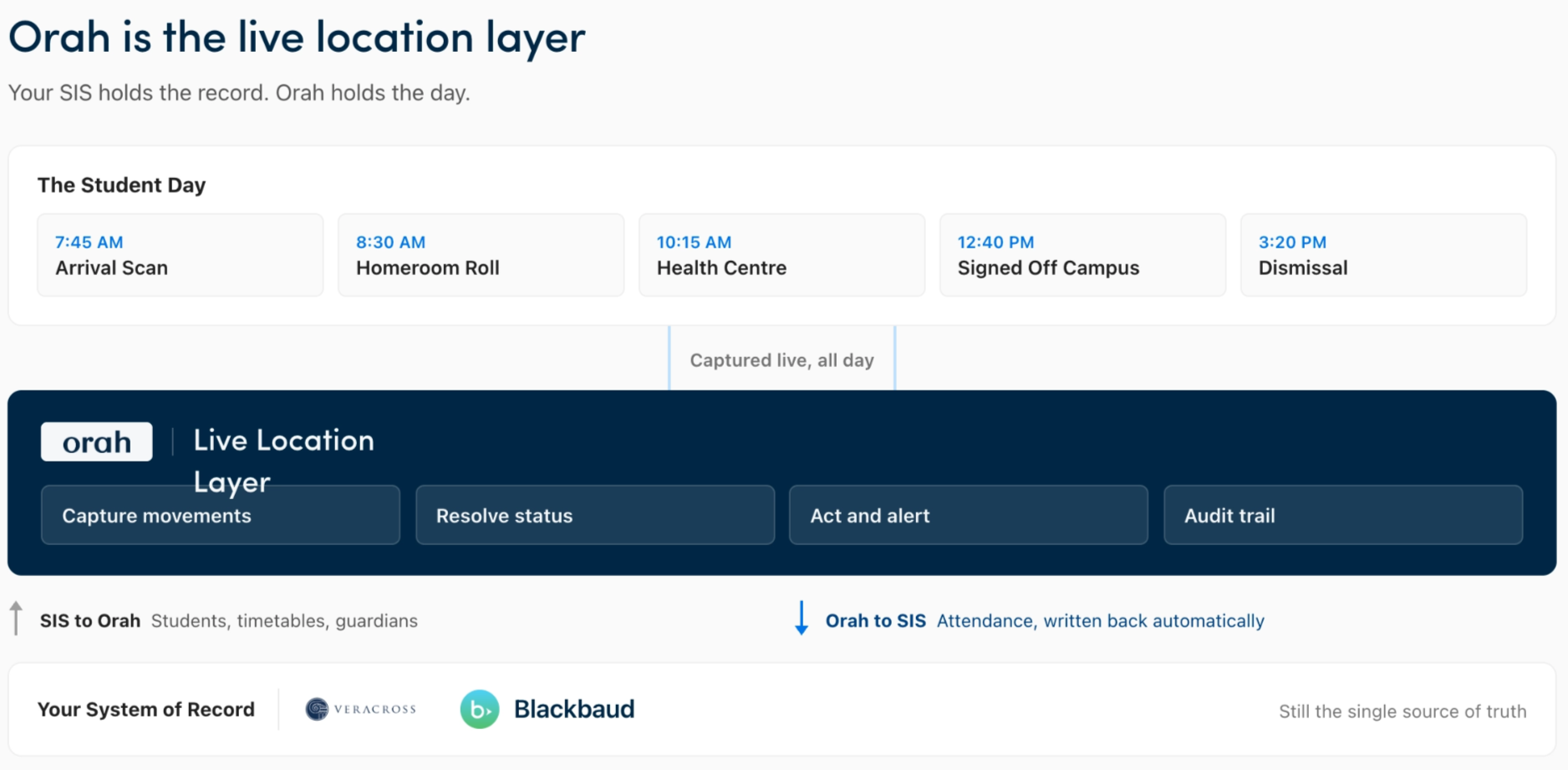
Worth naming directly, because it's a reasonable assumption. Veracross and Blackbaud are excellent systems of record, and most schools already trust them for the academic side of the picture: enrolments, timetables, transcripts, official reporting. That's exactly what they're built for.
What they're not built for is the real-time, minute-by-minute capture that live student-location requires, a parent submitting a pass, a student signing out on senior privileges, a teacher taking roll a few minutes later, and the two needing to line up instantly rather than at the end of the day. That's a different job: less "system of record" and more "live operational layer," and it's the problem Orah solves on top. Schools running Orah have parents using the Orah Families app, not the SIS's own parent portal, for exactly this reason: absence and pass submissions flow straight into the live roll and get reason-coded (Excused, Unexcused, Not Expected or Custom) in real time, so there's no separate system for the office to reconcile against what the teacher sees. Then the alerts and follow ups are automated in real-time to each stakeholder across every channel.
That distinction matters more now that attendance touches marks. A slower, end-of-day reconciliation process is fine for a compliance record. It's not fine for a number a parent can dispute in real time. Orah's job isn't to replace Veracross or Blackbaud, it's to give them better, faster, more precisely categorized data to work with, so the system your school already trusts for official reporting is working from an accurate, real-time picture rather than catching up to one.
Where Orah fits
.png)
1. Reconciliation that doesn't eat your morning
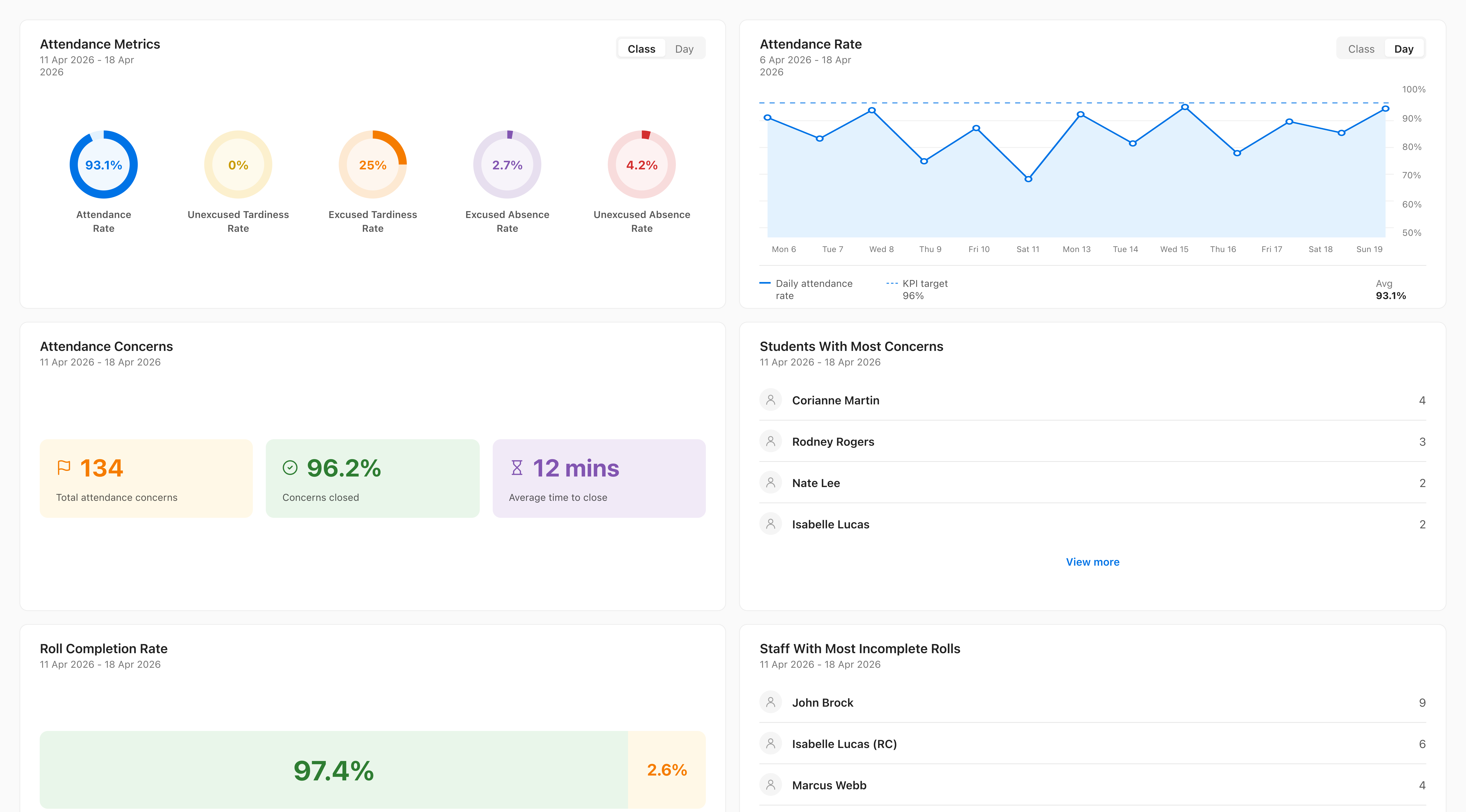
Orah's Daily Reconciliation view puts your entire day of attendance on one screen: Absent for the Day, Late for the Day, Overdue Rolls, and Passes, with live counts as the day goes on. Your Attendance Managers don’t have to switch between email, voice mails, your SIS and internal messages to reconcile what’s been happening - they can do it all from the same screen.
- Open any student's card and their schedule, passes, and contacts are right there, so you can call or email a guardian without leaving the page.
- Bulk-update roll codes and reasons across multiple students at once
- Send a teacher a single reminder covering every roll they still owe instead of three separate nudges.
- Anomalies or data mismatches are made clear and visible - think ‘marked absent-unexcused’ but they’ve been seen at every other class; well now it doesn’t
This is exactly the window that matters most now: the moments before automated parent notifications fire, or when a parent calls mid-morning asking where their child is, and it's also exactly where a mark-linked attendance policy needs the fewest errors.
2. Off-schedule location data that keeps reason codes accurate without extra work
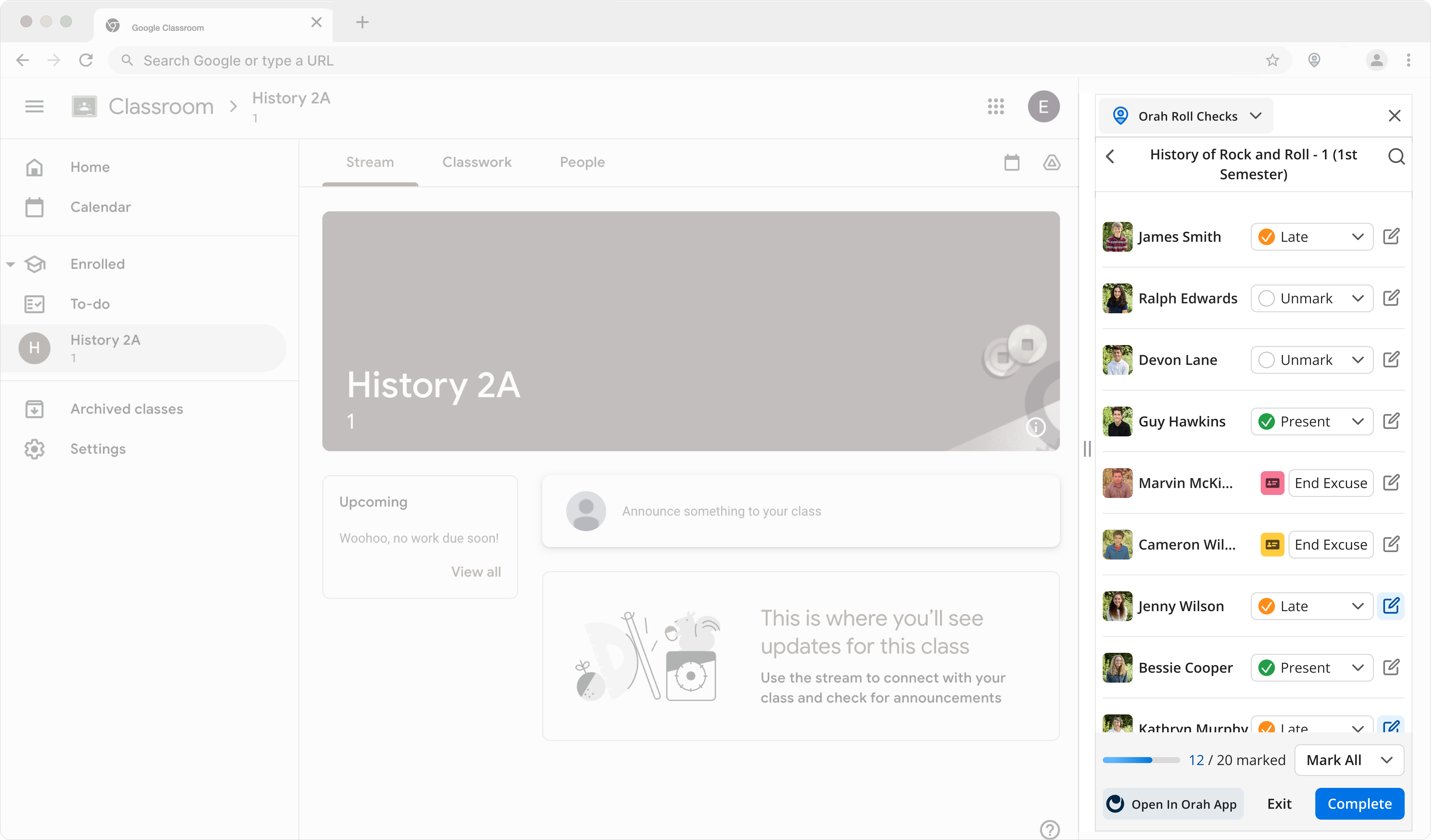
Orah's Pass, Location, and Attendance systems talk to each other automatically, no manual work to enter into the SIS. When a student is on an approved pass for common school use-cases, like senior priveledges, health center check-ins or field trips, their location updates in real time, and that feeds the roll in real-time so the student is "Not Expected" rather than unexplained, with the reason code attached from the moment it happens. Nobody has to manually cross-reference where a student was against what the roll says; instead it automatically squares this away and sends it back to the SIS.
3. Time-accurate attendance that gives you more control than a binary mark
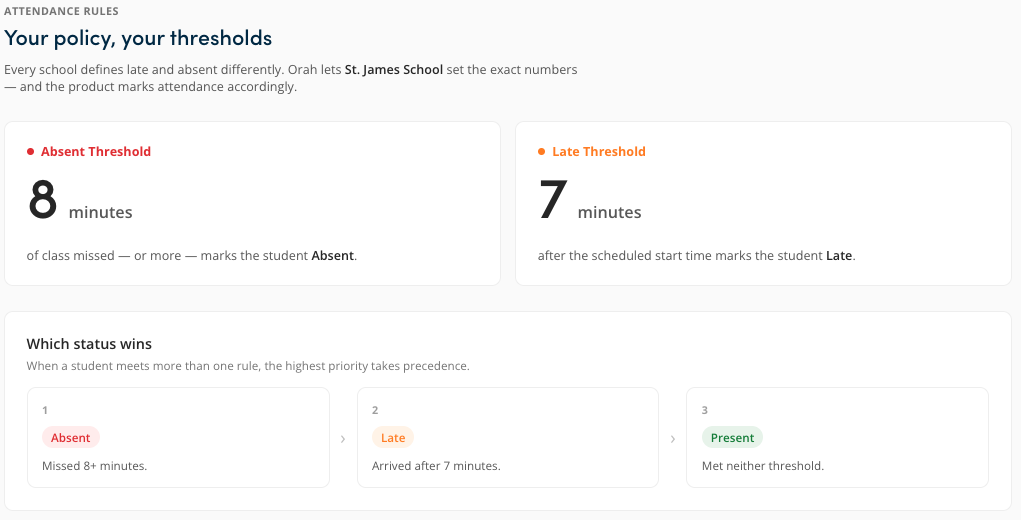
Right now, most SIS’ force a blunt choice when scheduling absences during class: present, absent, late without considering time as a factor. Orah has configurable, percentage-based thresholds so a school can decide what actually counts, for example, a student who misses 65% or more of a class is marked Absent, while missing less than that can be configured as Late instead. That's a meaningfully different (and fairer) picture for a mark-linked policy than a single and it scales school rules across every classroom without extra-work on the back-end.
4. Real-time omnichannel alerts to any stakeholder in the community
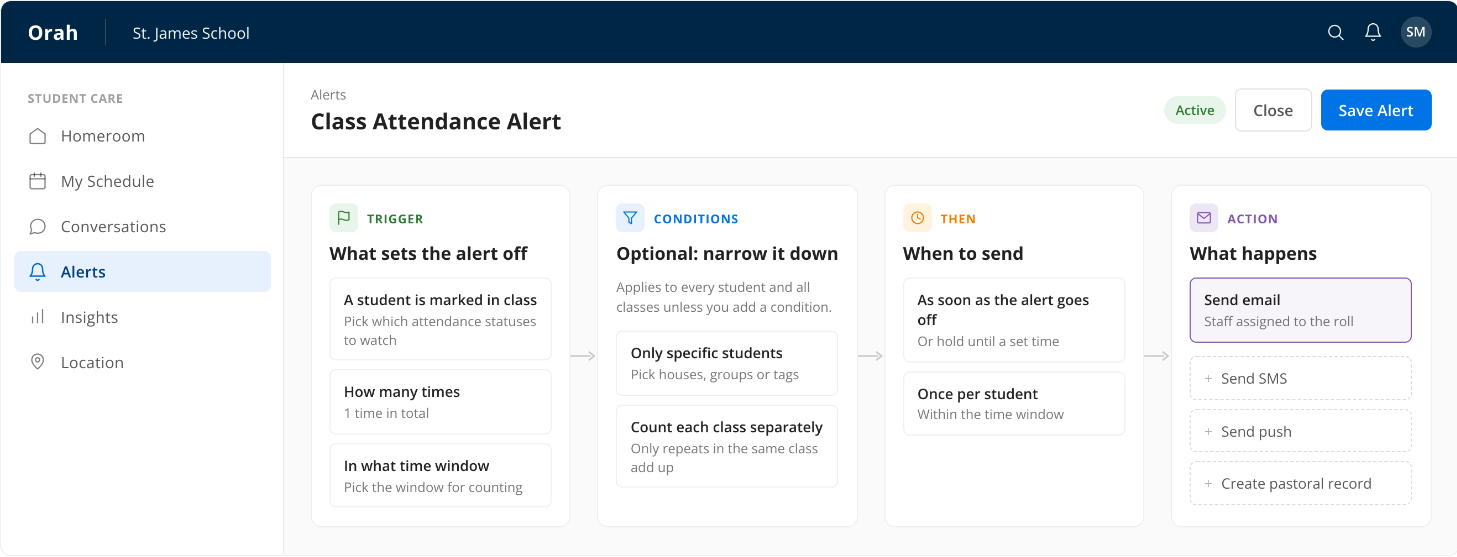
When something needs to reach someone, Orah sends it through the channel that actually reaches them: email and SMS to parents, email and SMS to students, email to staff, plus push notifications and in-app banners depending on the alert. A Dean doesn't have to be the single point of failure relaying information between a teacher, a parent, and a student; the right people hear about a late arrival, an overdue roll, or a pattern worth a conversation, in real time, without you manually forwarding it along.
The bigger picture
Whether or not your school falls under Ontario's specific mandate, the direction is clear: attendance data is being asked to do more than it used to, and the person who owns it day to day is the one who feels that shift first. Schools that treat attendance capture as an afterthought will find the gap exposed the first time a parent disputes a mark, and it'll be the Dean or Division Head fielding that call without good backup. Schools running Orah are already set up for the version of attendance policy that's coming: accurate, reason-coded, real-time, and audit-ready, before it's needed, not scrambled together after.
The same real-time location and alerting infrastructure behind this also underpins Orah's campus safety and emergency response tools, worth its own look if attendance data feeding a marks policy has you thinking about what else that same accuracy makes possible.
Download the 2026 State of Independent School Safety Report
In partnership with ATLIS and True North Research, we surveyed 85 independent schools across the US to create this 50-page report. Download your digital copy for free.

Currently based in Toronto. I enjoy exercise, sauna's and cold plunges, video games and design. Prior to Orah (10 years ago now!) I was a University Student studying my Masters of Architecture. There are two important things that keep me enthused at work - Using creativity to solve complex problems and working with good people.